
In today’s fast-paced world, vegetable cleaning machines are gradually becoming a new favorite kitchen appliance. They are not just for saving time and effort, but also for effectively removing contaminants invisible to the naked eye, ensuring dietary safety. This seemingly simple machine ingeniously combines principles from physics, chemistry, and engineering. So, how does it transform vegetables, covered in soil and potential pesticide residues, into clean, safe-to-eat ingredients? Let’s unveil the mystery behind its operation.
The operation of a vegetable cleaning machine does not rely on a single technology but rather on the synergistic effects of multiple purification principles. Its core goal is to remove three major types of contaminants: Physical (such as soil, sand, insect eggs), Chemical (such as pesticides, hormone residues), and Biological (such as bacteria, viruses).
Physical Cleaning (Mechanical Force): This is the most basic and crucial step. The machine uses forces generated by water flow to directly scour the surface of the vegetables. Whether it’s the tumbling vortex flow or the scanning water jets of a spray type, the essence is to use the kinetic energy of water to “wash away” loosely attached debris. This process simulates and amplifies our manual scrubbing action but is more uniform, continuous, and powerful.
Chemical Purification (Ozone and Hydroxy Water Technology): This is the key aspect where vegetable cleaners surpass manual washing. Most mid-to-high-end models are equipped with an ozone (O₃) generator or a hydroxy water generator.
Ozone Purification Principle: Ozone is a strong oxidizing agent. When the machine operates, the ozone generator produces ozone gas, which is dissolved into the wash water through devices like an air stone. Ozone molecules rapidly react with pesticide molecules (often organophosphorus, organochlorine compounds) on the surface of the fruits and vegetables, breaking them down into harmless carbon dioxide, water, and inorganic salts. Simultaneously, ozone also attacks the cell walls of bacteria and viruses, destroying their genetic material, thus achieving highly efficient sterilization and virus inactivation.
Hydroxy Water Purification Principle: This is a more advanced technology that uses special electrodes to directly generate highly active components, like hydroxyl radicals (·OH), in the water body. The oxidizing power of hydroxyl radicals is second only to fluorine, enabling faster, non-selective decomposition of almost all organic pollutants. The final products are only water, with no secondary pollution, making it safer and more environmentally friendly.
Buoyancy Separation: During the cleaning process, stripped-off impurities like soil and insect eggs, due to their density difference with water, will settle to the bottom or remain suspended in the water after the water flow calms, thus achieving physical separation from the vegetables.
Through the combination of these three elements, vegetable cleaning machines build a multi-dimensional, multi-layered cleaning network, ensuring the depth and breadth of the cleaning effect.
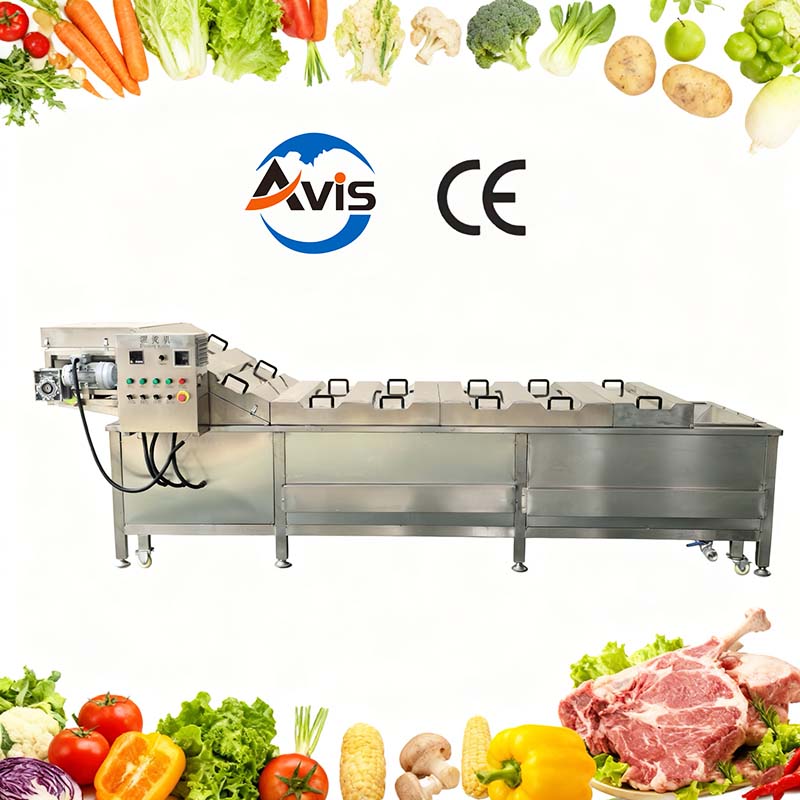
The workflow of a standard vegetable cleaning machine can be clearly divided into the following stages, much like a precise assembly line.
Preparation and Water Filling Stage: The user first places the vegetables to be cleaned into the washing basket and positions it inside the cleaning tank. Then, an appropriate amount of clean water is added to the tank, with water level marks usually indicating the maximum and minimum levels. Sufficient water is essential for ensuring water circulation and ozone dissolution.
Initiation and Circulation Stage: After closing the lid and selecting the desired program (e.g., Standard Wash, Power Wash, Sterilizing Wash), the machine is started. The water pump begins working, drawing water from the bottom of the tank and ejecting it through carefully designed nozzles or via the tank wall’s flow guide structure, creating a powerful vortex or waterfall-like water flow within the confined cleaning tank. The vegetables tumble and collide continuously within the basket, ensuring a 360-degree, non-contact冲刷 of their surfaces.
Purification and Decomposition Stage: Simultaneously with the start of the water circulation, the ozone generator or hydroxy water generator activates. The water flow, now rich with ozone or hydroxyl radicals, performs the chemical decomposition reaction while冲刷 the vegetables. This stage is the core of pesticide removal and sterilization, typically lasting 10-15 minutes. Users might sometimes see fine bubbles rising from the bottom and detect a faint grassy smell (characteristic of ozone), both signals that the purification process is active.
Sewage Discharge and Sedimentation Stage: After the cleaning cycle ends, the machine stops working. At this point, the contaminants in the water are in three states: heavier sand and soil settle into the lowest recess of the tank; some lighter impurities and killed insect eggs float on the water surface; and dissolved pesticide residues have been broken down. The user simply lifts the washing basket to remove the clean vegetables, leaving the turbid wastewater behind in the tank for disposal.
Self-Cleaning Stage (High-end Models): Many modern vegetable cleaning machines are designed with self-maintenance in mind. After cleaning the vegetables, the user can initiate a self-cleaning program that uses high-speed water flow to rinse the machine’s inner walls, preventing residue buildup and bacterial growth, and ensuring hygiene for the next use.
As mentioned, ozone and hydroxy water technologies are the two main “hearts” of vegetable cleaning machines, each with its pros and cons.
Ozone Technology:
Advantages: Mature technology, relatively low cost, high popularity. Very effective at removing most common pesticide residues and bacteria, with strong sterilization capability.
Disadvantages: Ozone has a distinctive fishy/grassy smell and can irritate the respiratory tract at high concentrations. It may cause slight oxidation on the leaves of some leafy vegetables (like lettuce), and prolonged use might slightly alter the taste. Furthermore, ozone has limited solubility in water and a short half-life, requiring continuous generation.
Hydroxy Water Technology:
Advantages: Stronger oxidizing power, faster and more thorough decomposition of pesticide residues. Its reaction products are only water, with no odor or secondary pollution, better preserving the taste and nutritional components of vegetables. It is regarded as a gentler and safer purification method.
Disadvantages: The technology is more complex, manufacturing costs are higher, and machines equipped with this technology are generally more expensive.
When choosing, consumers can decide based on their budget and their pursuit of ultimate food taste and safety. Hydroxy water technology represents the future direction, while ozone technology currently offers a highly cost-effective and efficient solution.
The vegetable cleaning machines on the market are mainly divided into countertop all-in-one machines and portable cleaners.
Countertop All-in-One Machines: This is the most common type, featuring a complete tank, built-in water pump, and generator. They usually have a larger capacity (3-10 liters), comprehensive functions, and strong cleaning power, making them suitable for fixed home use. Their design focuses on water flow formation and circulation efficiency, offering the most reliable cleaning performance.
Portable/Hanging Cleaning Machines: These products have a more ingenious design, typically consisting of a small main unit accompanied by one or more washing baskets. They don’t require a built-in water tank but instead use a basin or sink already in the home. During operation, the main unit is placed over the basin, and the washing basket is immersed in the water. It uses “water-electrode separation” technology to inject purifying components into the water in the basin to achieve cleaning. Their advantages are space-saving and flexibility, but the mechanical cleaning force primarily relies on manual shaking of the basket or weak water flow, generally being weaker than that of all-in-one machines.
Advantages:
Efficient Pesticide Removal: This is its core value, effectively addressing chemical pollution that hand washing cannot handle.
Powerful Sterilization and Disinfection: Removal rates for common pathogens like E. coli and Staphylococcus aureus can be as high as 99%.
Saves Time and Effort: Can clean a large quantity of vegetables at once, freeing up your hands.
More Thorough Cleaning: Far superior to hand washing for vegetables with many crevices, like broccoli and spinach.
Limitations and Usage Considerations:
Not a Panacea: It cannot remove internal pesticide residues or heavy metals within the vegetables; effectiveness is limited against systemic pesticides.
May Affect Taste: Prolonged ozone cleaning might make some leafy vegetables slightly wilted.
Requires Subsequent Handling: After cleaning, the wastewater still needs to be disposed of and the machine cleaned.
Power and Effectiveness: Actual results vary between different models due to differences in technology and power.
Future Prospects:
Future vegetable cleaning machines will become more intelligent. For example, using optical sensors to detect water turbidity to automatically determine cleaning time; connecting via the Internet of Things to smartphone apps to provide customized cleaning programs; or even integrating AI recognition technology to automatically identify vegetable types and match the optimal cleaning program. Furthermore, the integration of multiple purification technologies (e.g., ultrasonic + ozone + hydroxy water) will also become a trend, offering the ultimate guarantee of cleanliness.
In summary, the vegetable cleaning machine provides a scientific, efficient, and convenient solution for initial food preparation by simulating, enhancing, and surpassing the physical process of traditional hand washing, while incorporating powerful oxidative chemical purification technologies. While it is not a mythical “purification artifact,” it is undoubtedly a trustworthy technological guardian for modern households protecting dining table safety.
We are the best manufacturer of the products and can provide professional solutions for you. Please feel free to contact us for a quick quote now!

You can get a price of this model or send us any question to get any information you would like to know, we will reply to you soonest.